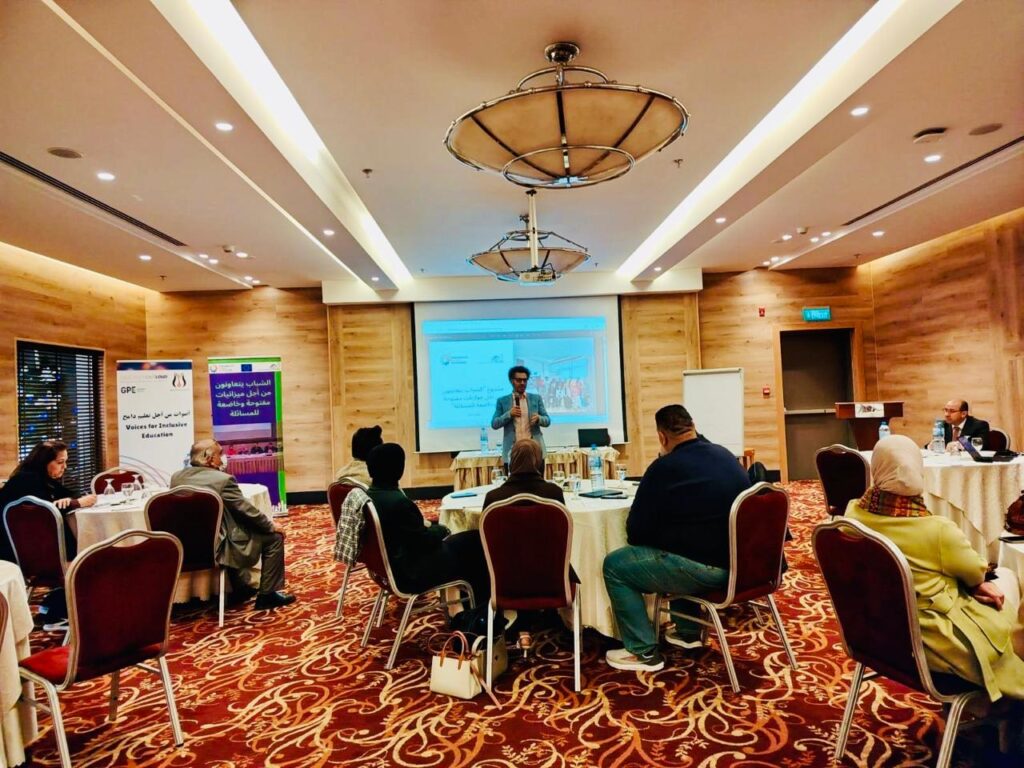
The Center for Change Agents participates in a specialized workshop to track and analyze the 2026 education budget.
In order to promote transparency, accountability and youth participation in analyzing public education funding, the Arab Network for Civic Education conducted a specialized workshop on tracking and analyzing the public budget with a focus on the education sector, within the framework of the project “Youth Collaborating for Open and Accountable Budgets” in partnership with the International Budget Partnership and with the support of the European Union in Jordan.
The workshop was attended by the Center for Change Agents for Sustainable Development, represented by the Media, Communication and Programs Assistant, Lana Al-Momani, along with 20 young men and women from various governorates of the Hashemite Kingdom of Jordan.
The workshop aimed to enable young people to understand, analyze and track the 2026 budget, with a special focus on education sector allocations, using a methodology based on social justice and a rights-based approach, thereby enhancing their ability to advocate for data-driven education issues.
The training included practical discussions on public spending priorities, mechanisms for planning and allocating public resources, and the role of youth in monitoring and participating in monitoring the education budget, in addition to reviewing the activities planned for implementation during 2026, which include community dialogues to evaluate education allocations at the governorate level with a focus on inclusion and equity.
Emad Imam, the regional coordinator for the International Budget Partnership in the Middle East and North Africa, stressed the importance of the role of civil society organizations in analyzing and tracking sectoral budgets in a way that promotes accountability and community participation.
This activity comes within the framework of empowering young people to read the numbers and turn them into effective advocacy tools that contribute to enhancing transparency and improving the quality of public spending in the education sector.